

TL;DR - Event Highlights
Witivio took the stage at the Microsoft Belgium Research Community (MBRC): “Accelerating the Research Workflow with AI” event, presenting groundbreaking agentic AI solutions that streamline research tasks and foster impactful collaboration. Their demonstrations emphasized how these technologies allow researchers to concentrate on hypothesis, creativity, and discovery, rather than routine work.
The real takeaway from this day? Agentic AI doesn’t replace human intelligence in research. It finally gives researchers the time to focus on what truly matters: the hypothesis, creativity, and discovery.
On March 9, 2026, the Microsoft Office in Brussels hosted a pivotal session for the Microsoft Belgium Research Community (MBRC): “Accelerating the Research Workflow with AI.”
Representing Witivio, Nicolas Humann (CEO) and Nadège Poncet (AI Consultant for Life Sciences), demonstrated why the future of R&D isn’t just about faster searches but about Agentic AI.
During a series of expert sessions, the event explored how AI can practically accelerate research workflows in impactful ways:
- Boost Productivity: Automate repetitive tasks like grant application drafting, meeting transcription, and progress reporting. Tech discussed: M365 Copilot, Agents (Copilot Studio and Microsoft Foundry) tailored to Researchers
- Streamline Development: Reformat legacy research code, debug software efficiently, and simplify complex workflows. Tech: GitHub Copilot tailored to Researchers
- Access Cutting-Edge AI capabilities: Securely tap into the world’s largest catalog of first-party, third-party, and open-source GenAI models and capabilities. Tech discussed: Microsoft Foundry, Azure AI
The Current Situation of Researchers
When a researcher spends almost 25% of their time searching for documents, they are losing valuable time that could otherwise be devoted to significant theories and world-changing discoveries.
Research institutions face also critical tension as free AI tools create data security risks (75% of enterprises block GenAI tools; 88% worry about data misuse), but research can’t move forward without AI assistance.
For research institutions, this translates to:
- Reduced publication speed leads to fewer citations and lower institutional rankings
- Lower grant success rates (less time for strong proposal development)
- Higher researcher turnover (PhDs leave institutions where they do paperwork instead of science)
- No traditional tool truly encourages interdisciplinary collaboration or helps people connect within an institute; researchers often remain isolated in their fields, limiting shared expertise and innovation
This Microsoft event sent a clear signal: this gap disappears when AI agents designed specifically for research workflows and adapted to the needs, clearly set the difference for institutions.
What Witivio Demonstrated: Copilot for Researcher
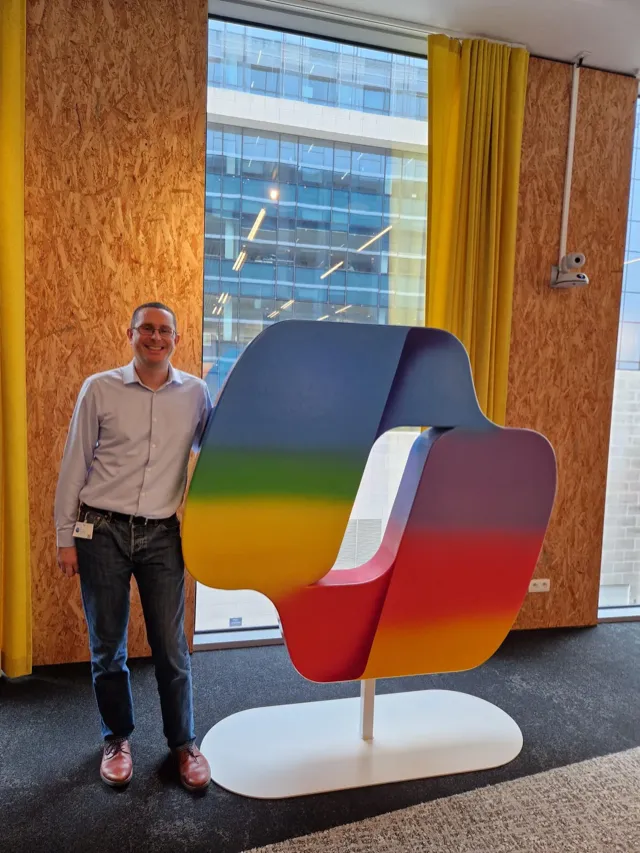
The enthusiasm resonated across every session of this MBRC event. Genuine, almost tangible, from both public and private R&D for agentic AI. Not AI as just a tool, but AI as an active collaborator in the most demanding phases of scientific work:
- Automated bibliography: no more hours wasted sorting through thousands of papers
- Drug discovery: agents capable of speeding up stages that used to take years
- Agentic coding: researchers and developers enhanced, with strengthened data analysis
Witivio didn’t attend the Microsoft Belgium Research Community to talk about AI in theory. The company took the stage to address how research institutions can actually implement AI agents without disrupting research culture.
“I had the privilege of presenting our team’s work on stage. Seeing our solutions resonate with researchers, scientists, and decision-makers from both academia and industry, that’s exactly why we do this job.”
- Nicolas Humann, CEO of Witivio
Nicolas Humann (CEO) delivered a compelling demonstration of the real impact that domain-specific AI can have for researchers. At Witivio, we’ve dedicated extensive time collaborating with the Curie Institute in Paris, immersing ourselves in the daily routines of researchers to ensure our AI solutions address their true needs. Leveraging the deep expertise of our Life Sciences AI Consultant, Nadège Poncet, we’ve honed our understanding of the unique challenges faced by research teams.
The result? Copilot for Researcher: a tailored AI agent expertly designed for research workflows, empowering institutions to accelerate their scientific output and transform collaboration. Witivio is the first European partner to develop research Copilot agents, with production deployments at Institut Curie (France’s leading cancer research institution) and ITER (the world’s largest international fusion research collaboration).
Copilot for Researcher is actively processing research workflows in one of Europe’s most demanding environments. It streamlines key tasks for scientists by automating literature reviews, patent searches, clinical trial identification, protein data retrieval, manuscript adaptation for journal standards, and internal expert discovery.
Beyond individual research acceleration, Copilot for Researcher creates institutional collaboration networks - identifying internal expertise, mapping who has specialized equipment - turning scattered knowledge into shared scientific intelligence.
Finally it solves free AI related tensions by providing enterprise-grade, institutionally controlled AI without the data exposure risk.
Copilot for Researcher is open source, built for transparency and reproducibility, allowing researchers to audit, adapt, and extend the solution for their specific needs. Witivio has built deep integrations with 15+ scientific data sources, from PubMed and Protein Atlas to clinical trials and biomedical repositories, ensuring researchers access verified, current research data. It transforms weeks of manual work into hours or days, enabling faster insights, improved compliance, and seamless collaboration. And because Copilot for Researcher operates inside Microsoft Copilot (where your researchers already work), there’s no adoption friction, no new software to learn, no change management nightmare.
What sets Witivio apart is that, as a “Frontier Partner,” we provide a secure, Microsoft-verified infrastructure that ensures your research data stays private while your discovery speed accelerates.
Why AI Matters for Your Research Institution Right Now
What the MBRC event revealed is that research institutions are ready, and Microsoft is signalling its commitment. And vendors like Witivio who have built domain-specific solutions in production with Tier-1 research centres (Institut Curie) are positioned to help institutions move from readiness to actual deployment.
The question isn’t whether agentic AI is coming to research. The question is whether your institution moves with the market or watches competitors establish an advantage.
Microsoft Belgium Research Community confirmed three operational realities:
1. Deployment speed is an institutional competitive advantage
Institutions moving now will establish a competitive advantage over those who wait. Early movers will publish more, secure more funding, and attract more talent while slower institutions are still in evaluation mode.
2. Domain expertise matters more than AI capability
Generic AI platforms are commoditizing. What differentiates is whether a partner understands your specific workflows, your data sensitivities, your collaboration patterns, your compliance requirements - so for your institution to use the correct AI that works in full security and respect of your normative.
3. Teams-native integration removes adoption friction
And because Copilot for Researcher operates inside Microsoft Copilot, where your researchers already collaborate daily, implementation means zero new software, zero new training, zero change management burden. Just capability where your team already works.
Next Steps: How to Get Started
The Microsoft Belgium Research Community made one thing clear: the market is moving. The institutions that move with it - deploying agentic AI soon - will define research competitiveness. The question for your institution is simple: are you moving with the market, or watching it move without you?
If you’re responsible for research workflows, research IT, or research strategy:
Related Articles
Frequently Asked Questions
Frequently Asked Questions
Agentic AI doesn't replace human intelligence in research - it finally gives researchers the time to focus on what truly matters: hypothesis generation, creativity, and discovery. The event made clear that research institutions are ready to adopt AI agents now, and the competitive advantage belongs to those who move first.
AI Agents are autonomous systems that go beyond traditional AI tools like ChatGPT. While ChatGPT responds to individual questions, AI agents can understand complex multi-step tasks, make decisions independently, invoke multiple tools without constant human direction, and act autonomously. An AI agent can handle an entire research workflow - all with minimal human intervention.
Copilot for Researcher is an AI agent tailored for scientific workflows, automating time-consuming tasks like literature reviews, patent checks, clinical trial searches, protein data retrieval, manuscript formatting, and internal expert discovery. It also builds collaboration networks by mapping expertise and equipment. Operating within Microsoft Copilot, it eliminates adoption friction and change management issues.
Copilot for Researcher solves this by providing enterprise-grade, institutionally controlled AI without data exposure risk. It's open source (available on GitHub for transparency and auditability), built with Microsoft-verified infrastructure designed for biomedical research security standards, and your data stays within your institution's control. Unlike public AI platforms, Copilot for Researcher is designed from the ground up for sensitive research data.
We start with a Discovery Workshop where Witivio works with your team to understand your specific workflows, pain points, data sources, compliance requirements, and technology stack. The workshop results in a concrete roadmap. Next comes the Technical Setup: configuring the agent infrastructure, connecting to your data sources, and building the agent logic. Then Deployment: rolling out the agent to users with proper change management and adoption support. Finally, Adoption Planning: training key users, setting up communication strategies, measuring impact, and planning next phases. This can take from 2 weeks to 3 months.